AzraqThe Dead Sea was the end of the Mountain Travel Sobek itinerary. We arranged to have our MTS driver Ahmed drive us to Azraq, a small city about 100 miles east of Amman. We were to stay in the lodge at the Azraq Wetland Reserve. The lodge is right next to a U.S. Air Force base. Occasionally we heard fighter jets landing and taking off, even in the middle of the night. We wondered if the activities were related to the war in Syria. Near Azraq, there are several castle ruins, a wildlife reserve, a wetland reserve and a Syrian refugee camp.
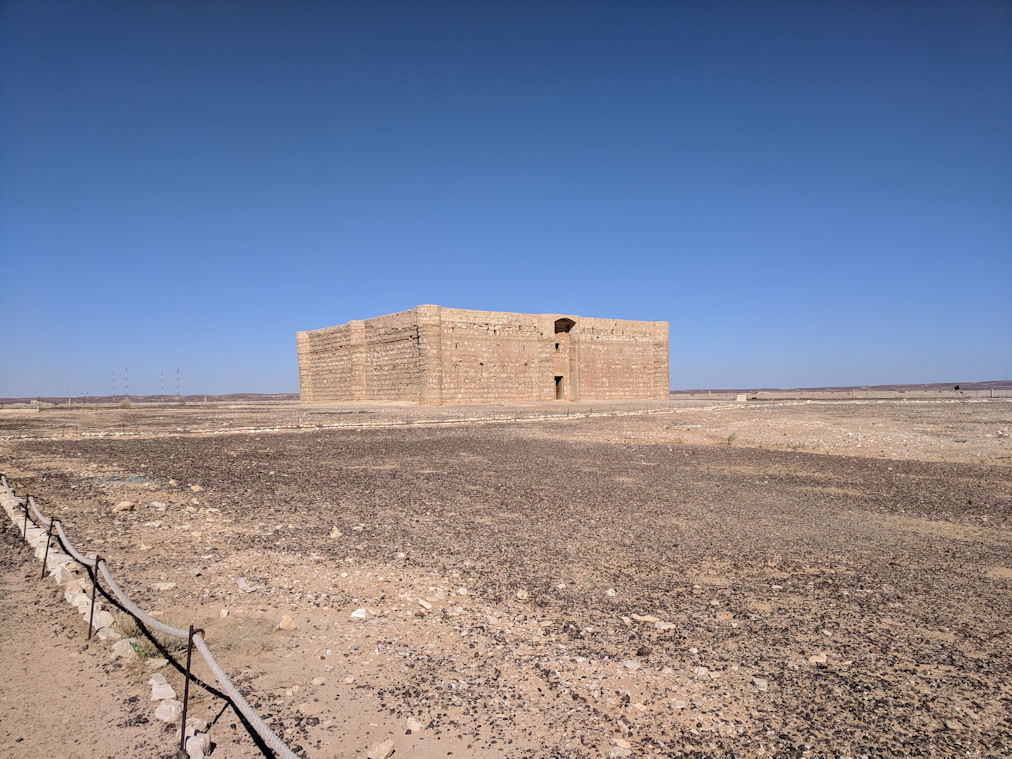
The highway to Azraq was well-maintained and went through a wide swathe of desert with minimum vegetation. We stopped along the way at two Qusayr (Crusader or earlier castle-fortifications). The first Qusayr was Harrana. It is actually considered to have been an inn. It has beautiful simple and symmetrical architecture with round towers at each corner, a central courtyard and stairs to second floor on each side of entry. Inside are stones faced with stucco. At first the interior looked plain and simple – then we noted a more decorated larger room at the end opposite the front entry. It had round arched interior walls and a dome.
The second Qusayr was Amra, which we had heard about because of its unusual frescoes with scenes of wild animals, hunting, fruit and wine consumption, and naked women. It was built early in the 8th century by Walid Ibn Yazid, the future Umayyad caliph Walid II. It is considered one of the most important examples of early Islamic art and architecture. Interestingly, the presence of men and naked women in these frescoes differ drastically from the aniconism (the avoidance of images of sentient beings) practiced in Islamic art today.
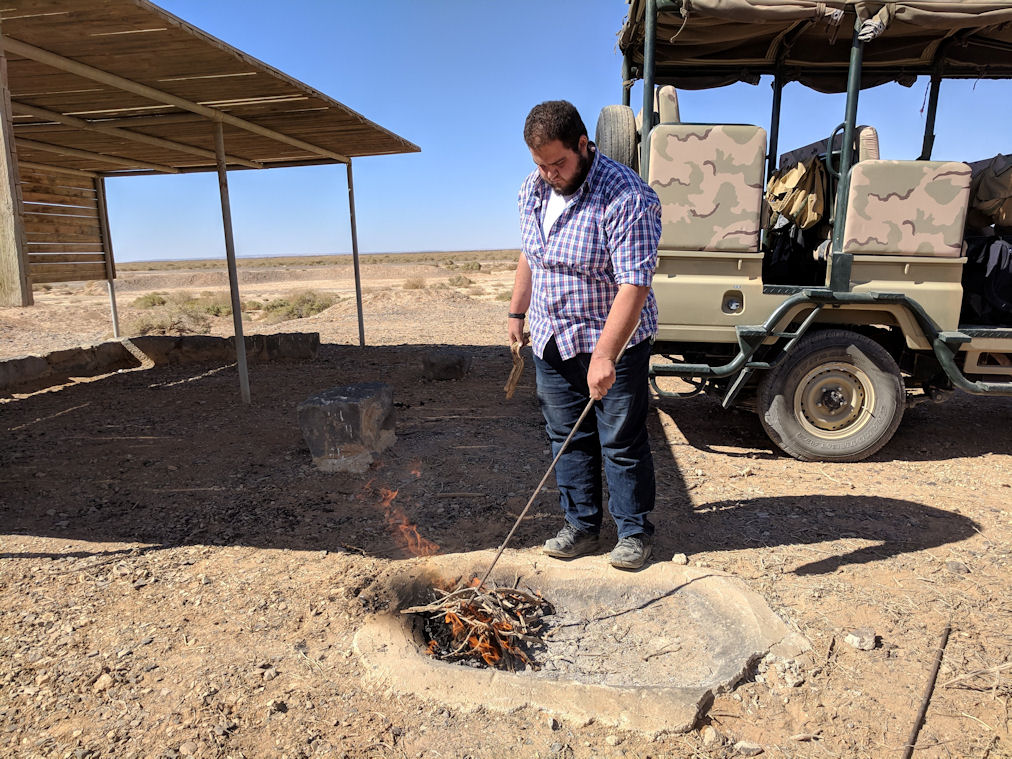
An Italian restoration specialist was there working. He explained that he comes from Italy several times a year, when funding permits. Earlier attempts at restoration (done by Spain) used shellac which yellows with age. He and a woman restorer are removing the shellac with chemicals and adding a protective layer. It is a joint project of Italian Arts Commission, and maybe the U.N, as well as Jordan government. At the gift shop in a Bedouin tent at the gate, a guy in Western clothes gave us sweet tea and wrapped a Bedouin scarf around David’s head. He said he had worked at the nearby US military training academy in Azraq, working for Blackwater. He likes the Americans, made friends with them We had made reservations for the Azraq Lodge before we left the U.S. through the Royal Society for the Conservation of Nature. We ran into bureaucratic intransigence. "You have to send your credit card information by email. No exceptions!" "No we do not arrange transportation to and back from Azraq." "No, you cannot pay by credit card" (even though you have to give them credit card information). At the Azraq Lodge, it was much more relaxed. The front desk guy worked hard over our two days to get us guides for activities. We used credit card for payment. He arranged a car to drive us back to Amman. Where were the people that we had interacted with before the trip? Apparent they are desk-jockeys at the headquarters in Amman. We did two tours. The first was a jeep ride in Shaumari Wildlife Reserve with four others - a Swiss couple and two Dutch guys. The Chechen man giving us the tour in the jeep spoke excellent English. He was born in Azraq and his family has lived in Azraq for generations. (We didn't know that Chechens had migrated from Russia so long ago). The town of Azraq has Chechen, Druze and (Jordanian? Bedouin?) residents. We saw the Arabian Oryx, brought back from the brink of extinction by collecting a herd from various zoos around the world; a type of gazelle; and a donkey-horse.
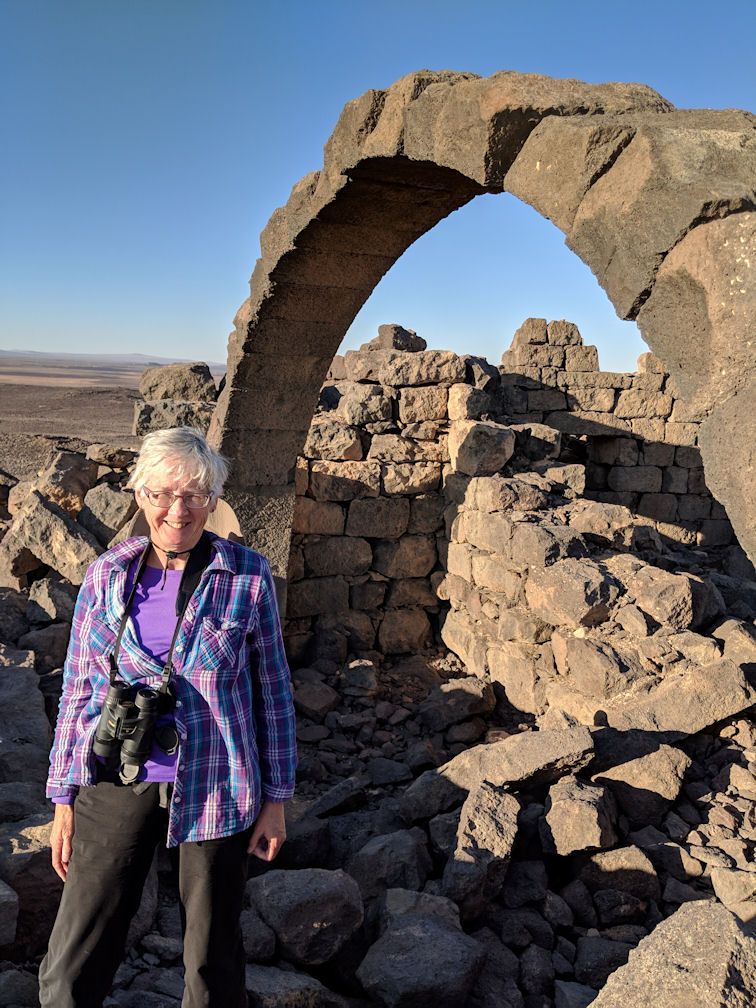
Without ever providing or allowing us time for lunch, a driver and guide took us to two castles. The first, Usakhim Castle, was on top of a hill 30 miles northwest of Azraq. We bumped and jostled in a 4-wheel truck up a pothole-ridden, rocky trail off the highway. The area is very rural surrounded by inhospitable desert of amazing rubbly rocks. The qusyr had one beautiful dark stone arch still standing. The second, Azraq Castle, was back in Azraq. It is best known for Lawrence of Arabia having a headquarters here. It has a beautiful inner mosque but overall dates back to the Romans.

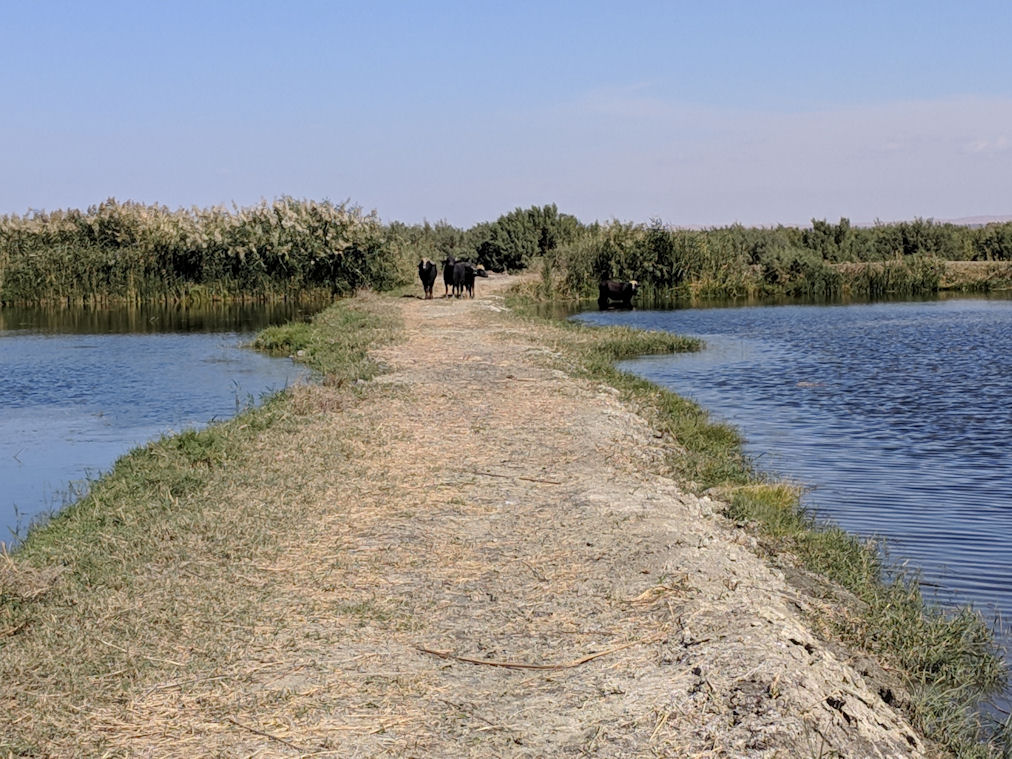
Finally in late afternoon we had lunch with a local Druze family in Azraq. There was chicken and rice with many assorted salads, olives, pita bread. The husband of the family carried on a conversation with our guide. They basically ignored us since probably he does not speak English, but the guide, who spoke English, didn't try to involve us in the conversation. On the wall, the Druze symbol- a five-pointed star with each point of the star a different color – red, white, green, yellow, and black. Do they represent the 5 Druze communities that came together? When? Arab unity? Ottomans? We got no answers. It was an awkward and not a satisfying experience. (This is clearly not the MTS/Ayman tour!) The front desk guy phoned the wetland reserve – the next day they would give us a guide for 2 hours on the long trail. We were not allowed to go by ourselves due to the 14 water buffalo. Our guide, Anwar, was very light-skinned, Caucasian-looking. He has only been on this job for one month but knew some of the birds. We saw Great White Egret, coots, moorhen, common kingfisher with lovely rust-colored patch on back, and many cute little bright green frogs, with only their eye bumps showing above the water. We didn't get zoom-in photos of them - David broke his Canon camera earlier. It is amazing to see so much water in the dry desert. The water likely is pumped from an underground aquifer since we didn't see any streams.
Anwar’s prior job was working with Syrian refugees at the very large refugee camp in Azraq. We learned that in the camp meals are not served in mess halls. Instead, coupons are provided for food. Families live in individual tents and cook their own meals. They can work for short periods (not more than a month at a time) outside the camp. (Note: Ayman’s sister, who is married and has kids, volunteers for an NGO, teaching English to Syrian refugees.) About 4 or 5 pm, we hired a driver (arranged by the front desk) to take us to the Amman airport. He was a Druze who spoke good English. He went to Damascus University where he studied English literature and has been an English teacher. His teaching job was with the Iraqi troops working with the Americans. He loves Shakespeare and Emily Bronte’s Wuthering Heights. It amazed us that in the middle of nowhere in Jordan, he was raving about Wuthering Heights. He got stopped by local police soon after we started out from Azraq, due to having shades over side windows, which is illegal. He said he needed the shades for his kids. He didn't seem to care about the ticket. We wondered whether he would pay it. He talked about forgetting his English now – we guess he is no longer working as a teacher. David asked him about the Druze symbol, which he explained. He’s not very religious, but it was important to marry a Druze woman. It is his community. We got to airport and enjoyed seeing a big assemblage of family and friends welcoming one of their own back from overseas somewhere – bagpipes, lots of big drums, really loud and happy group, some singing and dancing (video). After waiting at the airport for 7 hours, we flew home via Paris. EpilogueMTS and Ayman provided us a superb tour. We could not have asked for a better guide than Ayman. The combination of trekking, cultural and historical touring is perfect for us. The couple of surprises (the narrow canyon with 2000-year old ruins of a Nabatean dam, and the Mars-like setting of the Sun City Camp) made it even more memorable. We had never been to the Middle East. This trip was an eye-opener for us. While there is a war going on in Syria, we did not feel unsafe even though on one occasion (in Jerash) we were less than 30 miles from the Syrian border. Jordanians just go about their daily lives apparently not being bothered by the war. This reminded us of a similar situation when we visited South Korea in 2013. Tension was high as North Korea was sabre rattling. We even saw missile-armed S. Korean fighter jets flying over a national park less than 30 miles from the DMZ. But we didn't see anxiety in the face of the South Koreans. We didn't see the hundreds of thousands of Syrian refugees either. Jordan has welcomed Palestinian refugees in the past. When asked about it, Ayman told us that the traditional Bedouin hospitality to strangers is the main reason why Jordan accepted so many newcomers. We don't know how true this is, but we sure did experience this hospitality as the Bedouins always served us tea when we dropped by their stores, even though we didn't buy anything. During the entire trip, we dealt with men most of the time. The only time we saw a significant number of women working was near a court house in Amman. We saw many well-dressed women holding papers in folders going in and out of the court house. They all wore head scarves. Ayman and our driver, Ahmed, told us that 60% of the women do not wear head scarves. But that was not our experience. Practically all women we saw/encountered wore head scarves, in Amman and in the countryside. We don't get it. Maybe what they meant is 60% of the women do not wear hard scarves in the presence of their friends, but not in public. When we first met Ayman, he told us that there is good news: the Syrian border just opened. He sounded like it was a big deal. We were sort of puzzled since we didn't hear about this "big event" even though we do pay attention to Middle East events, especially around the time when we travelled. On the other hand our driver Ahmed told us (when he drove to Azraq) his view of the Syrian refugee situation in Jordan, which was much darker than Ayman’s. He has two kids in school, his wife is a teacher at their private school. Schools are overcrowded, presumably because of refugees. When one border entry into Syria was opened for the first time since the war conditions became desperate, only 35 people went back because of continued danger from the Assad regime. “A few people are going back to test the conditions. If they stay safe, others may follow.” 
==== THE END ====
|