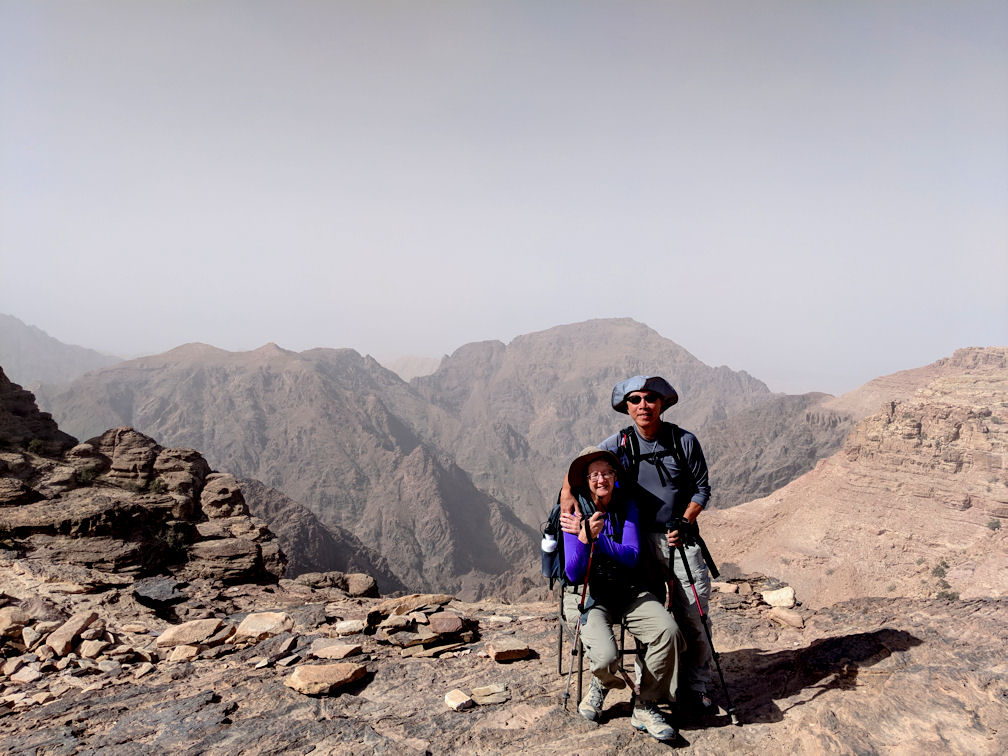
PetraThe next day we hiked 11.4 miles from Little Petra to Petra. It was long but relatively easy due to small elevation gain. This route entered Petra via ‘The Back Door’. We saved the regular entrance to Petra via Siq for the next morning to avoid the crush of the tourists.
David dropped his Canon camera and shattered the LCD screen in the early part of this leg. While the rest of the camera still worked, there was no way to see what photo you are taking. Luckily we still have two Pixel phones which take great photos. However, we did not have the 40 optical magnification of the Canon anymore.
The first building we saw in Petra is the Monastery, one of the legendary monuments of Petra. It is located up in the hills at the northwestern outskirt of Petra. Like most of the rock-cut buildings in Petra (and Little Petra), it is essentially a facade. Some buildings have a small chamber (those with an opening). Some chambers are empty, some with niches and triclinium (U-shaped rock-cut benches) inside. The entire building was created by cutting away sandstone on the hillside, using hammers and chisels. The carving started at the top of the building/hill. Scaffolding was provided naturally as the rocks got cut away. The Monastery was built in the 3rd century BC as a Nabataean tomb. It derives its name from the crosses carved on the inside walls, suggestive of its use as a church in Byzantine times. This 2300 year old building is in an amazingly good shape. Ayman told us the top parts of the Monastery are the original, i.e. no restoration has been done. The aqueducts carved into the rocks near the top channeling away water partly account for its good condition. The dry climate in the region also helped.
We walked down a Nabataean rock-cut path of more than 800 steps to the main part of Petra. We had a much easier walk than most of the tourists since they have to hike from Petra below. It opens up into a wide valley at the end of the stairs. There are many temple ruins on either side of a broad boulevard (Colonnaded Street): the Great Temple, Temple Qasr al-Bint and the Winged-Lion Temple. They are in various stages of being excavated. These free-standing ruins were a big surprise to us. We thought all the buildings in Petra were carved out of rocks.
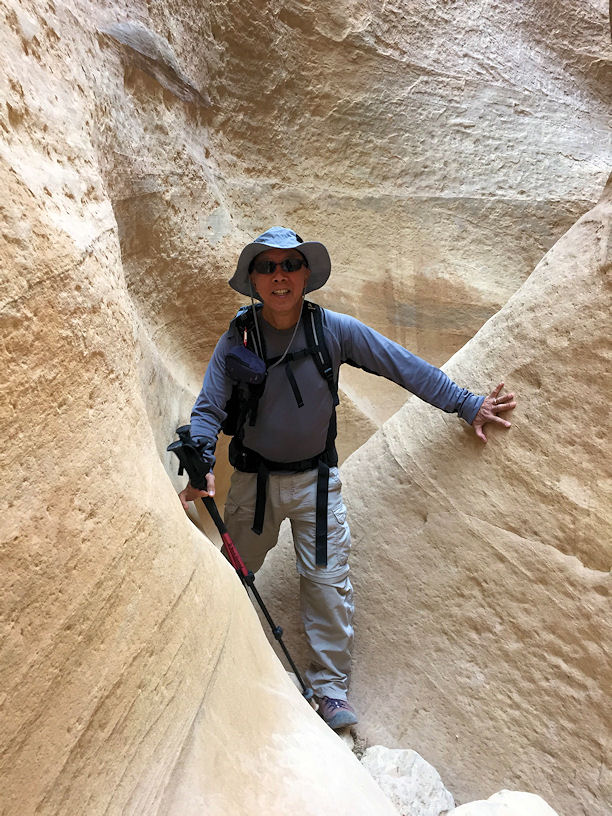
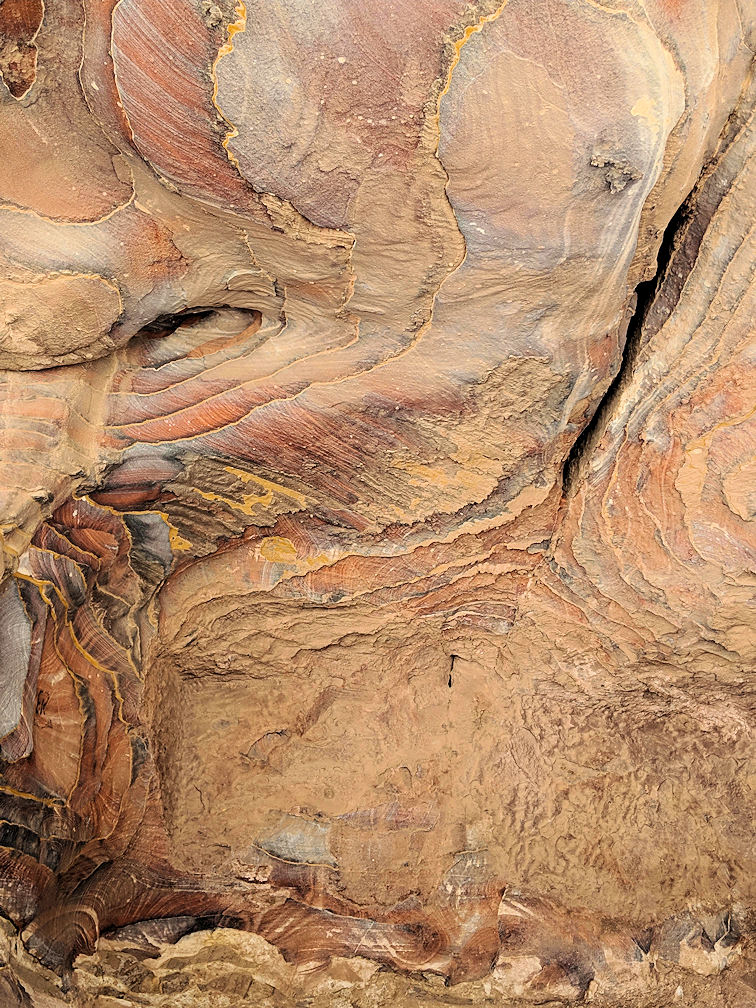
We did not linger long in the ruins. Ayman took us to a surprise trek - he hinted it to us the day before but indicated that it would be weather dependent. We went to the north side of Petra into a narrow canyon (Wadi Muthlim) for an adventure of clambering. We admired the wind-and-water carved sandstone, Nabatean niches for gods and the remnant of a 2000-year old dam.

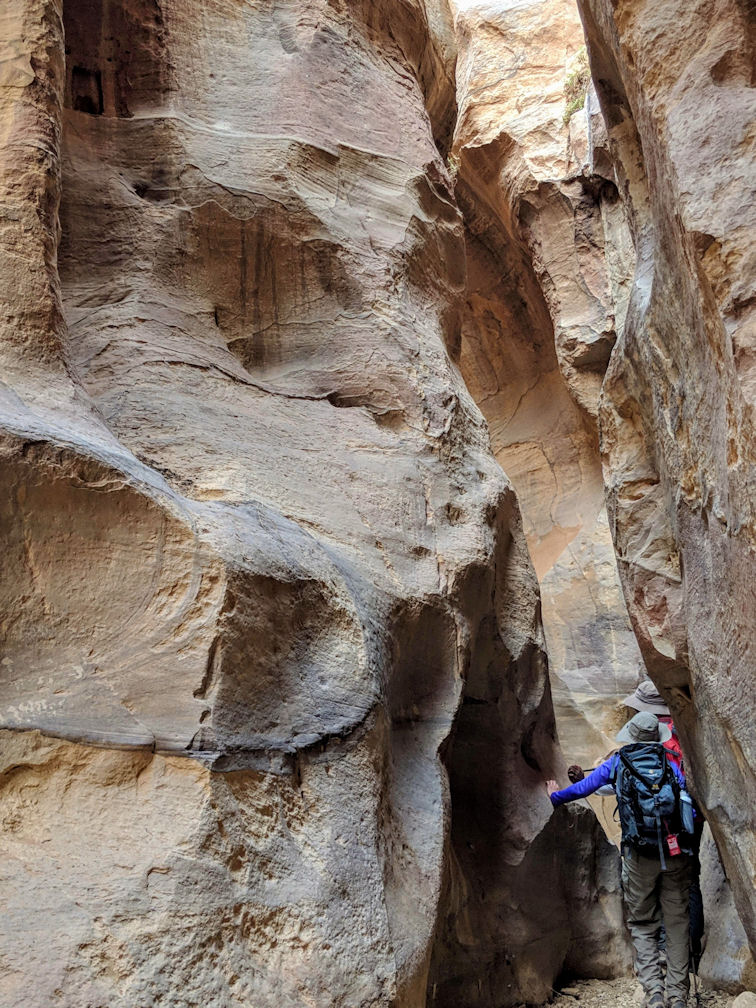
At the end we walked through the tunnel the Nabateans carved two thousand years ago. It was recently rediscovered (it was buried) when tourist agencies realized a tunnel was needed in cases of flash flooding, to carry away water that would flood Petra – as it did just a week or so after we returned to the U.S. After the tunnel, we came into the main village of hotels outside the entrance to Petra. Ayman bought us a beer in a courtyard of a hotel next to Petra entrance before we checked into our hotel (Movenpick Resort Petra). We went to the main entrance of Petra the next morning. We walked three quarters of a mile along the Siq, a narrow dim canyon. But it is not nearly as narrow as the canyon we hiked yesterday. At the narrowest part, it is 10 ft wide, barely wide enough to accommodate horse-drawn carriages for tourists. Ayman warned us to stand to the side in a downslope when a carriage came by because the horses (and carriages) cannot stop easily on the smooth rocks.
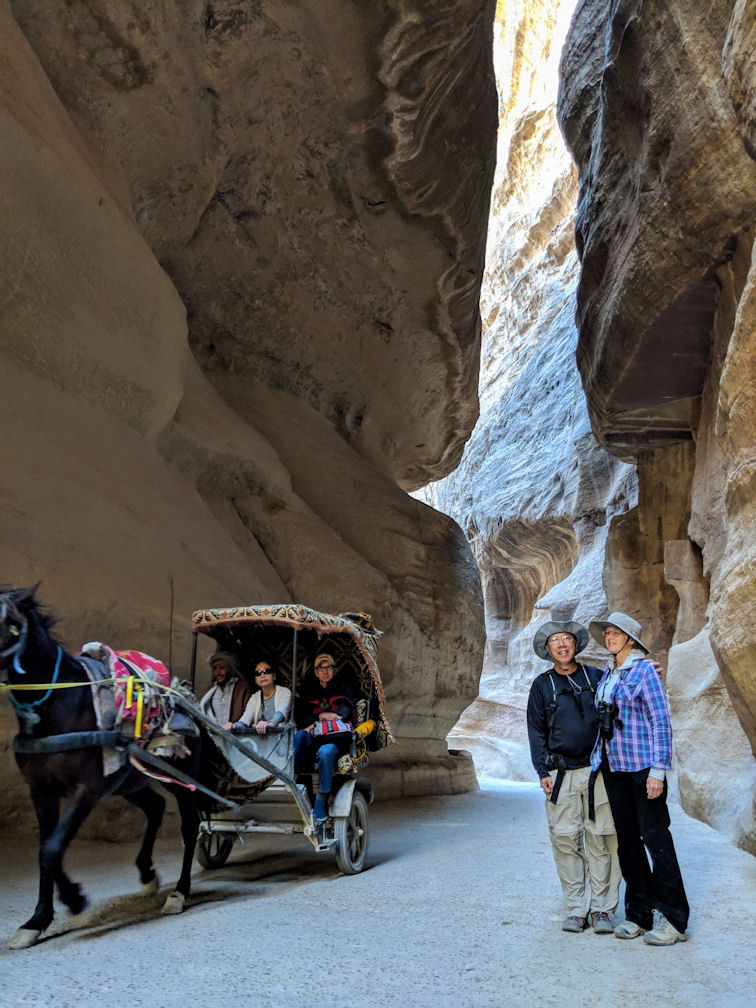
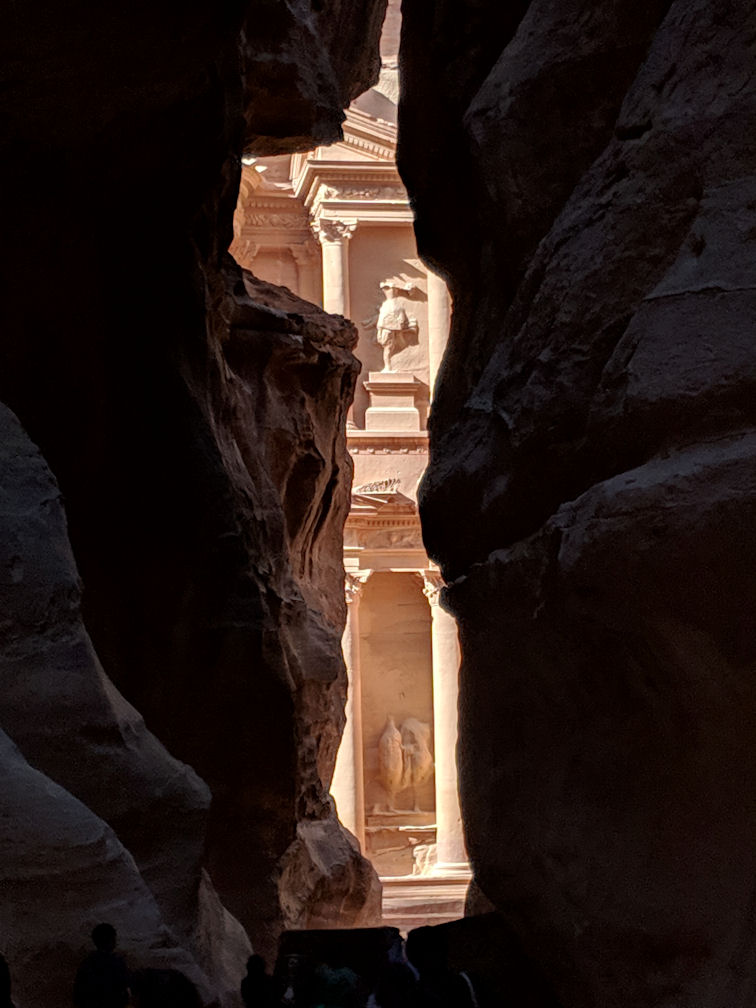
At the end of the Siq is the Treasury. It is one of the most elaborate temples in Petra. The structure is believed to have been the mausoleum of the Nabatean King Aretas IV in the 1st century AD. It became to be known as "Al-Khazneh", or The Treasury, in the early 19th century by the area's Bedouins as they had believed it contained treasures. It was swarmed with tourists as it is one of the most popular tourist attractions in both Jordan and the region.


Outside the Siq and away from the Treasury, there were many more buildings, some of which were not even finished. We passed some tombs that in ancient times had several bodies stacked on top of each other. Each body was encased in sand, then stone slab above, then next body above etc – up to 6 or 7 stacked on top of each other.

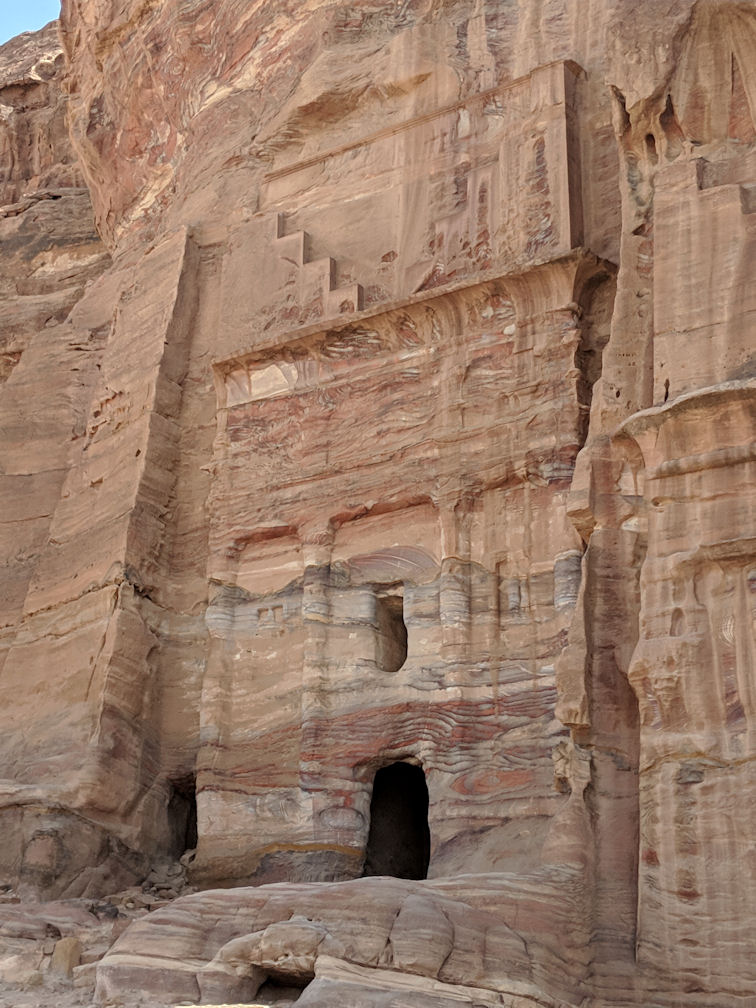
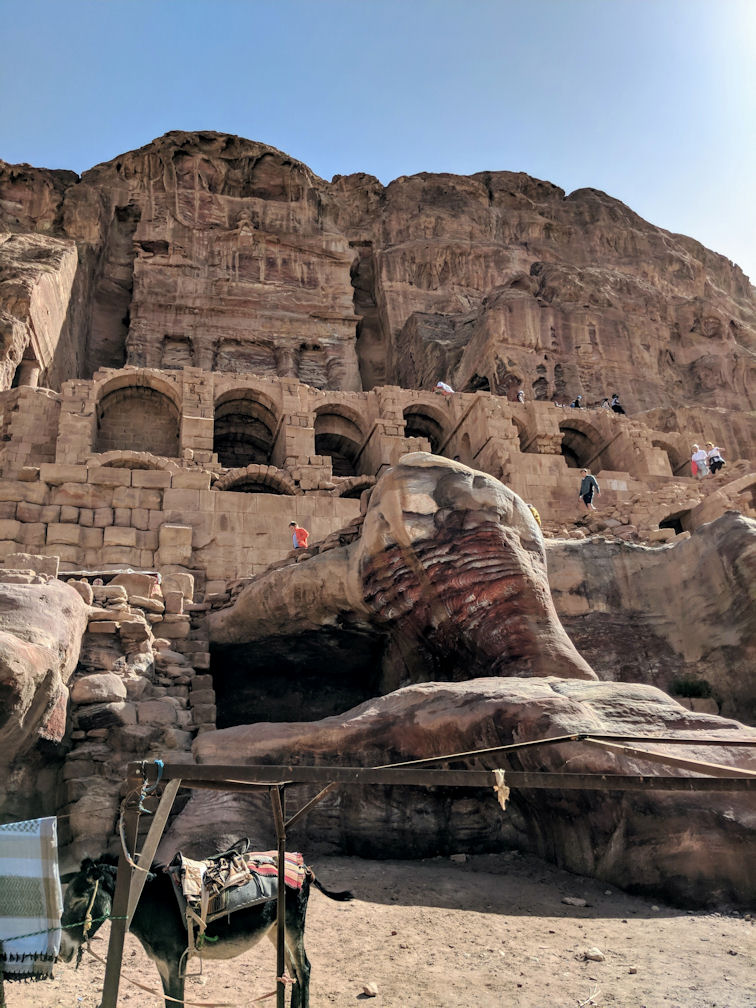
Thanks to Ayman, we got to talk with Rami, the son of Marguerite, author of Married to a Bedouin, who is running the family gift shop outside Petra. Sally bought a silver pendant designed by Marguerite – symbol is the Nabatean god of gods. Rami was fun to talk to. He told us that his mother had realized she was living a life that was rapidly disappearing and decided to write about it after taking writing classes at the local college. She is back living in Jordan because all three kids are now there. We didn't meet her since she was staying at home that day.
|