
Kiso ValleyThe Nakasendo, one of the major Edo-period post roads, runs through the Kiso Valley. Parts of the old trail between the villages of Tsumago and Magome remain much as they were in the Edo days. Furthermore, both of these villages have retained buildings in the traditional style, another reason to visit the Kiso Valley. Despite the excellent train system in Japan, the journey from Takayama to Tsumage was complicated. First we took a three-hour train ride back to Nagoya. From there, we took a one-hour local express train to a town called Nakatsugawa. Then we hopped on a local train for a 20-minute ride to Nagiso. Finally we took a 15-minute bus ride to Tsumago. It took us longer to travel this leg of our trip than to travel from Tokyo to Kyoto by shinkansen. 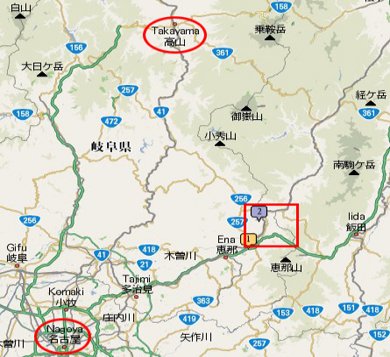

Takayama, Nagoya and Tsumago region, all marked in red. Enlarged map of Tsumago region with Nakasendo trail that we hiked.In cities, many road signs are in English and most trains have announcements in English following the Japanese. But as we got farther from the urban areas, English became less common. The Japanese language itself makes it very difficult for English-speaking tourists to get around in Japan. Japanese can be written in one of two phonetic systems (similar to an alphabet), kanji (Chinese characters), or romaji (Japanese written using the Latin alphabet). David knows a lot of kanji, Alice and Philip can read both of the Japanese phonetic systems (hiragana and katakana), and all four of us could pronounce the romaji. Therefore, it becomes harder to navigate in rural areas, where road signs are written only in kanji which our English guidebooks often didn't include. Tsumago was full of tourists in the daytime, but after 5 pm all the tourists went home and it was pleasant and deserted. We stayed in a ryokan(traditional Japanese inn) for two nights. The floor of our room was covered with tatami mats (woven from straw) and contained a low table but no chairs. The room was mostly empty during the day, but at night futons were spread on the floor so we could sleep. There was no air conditioning in the room, but luckily the temperature in the mountains was significantly cooler than the cities and coastal areas.  A traditional Japanese house in Tsumago. Nagiso,a small, modern Japanese town.The ryokan served us traditional and fancy meals for breakfast and dinner. There were no menus: we simply ate what they served us. Typically the meals consisted of many small dishes of pickled vegetables and meat or fish. We ate typical food like tempura, miso soup, and pan-fried whole fish. There were also a few more unusual items: sweetened grasshoppers, raw tuna, and slices of raw horse meat.  Inside the ryokan: our room is through the open door. Dinner at the ryokan.On one day, we hiked from Tsumago to Magome on five miles of the old post road, and then took the bus back to Tsumago. The road goes through some farmland so we had a closer view of farmhouses, rice fields and forests. Despite the population pressure, much of the hills remains forested. Near the end of the hike, we were caught in a thunderstorm, but fortunately we had umbrellas.  The old post road between Tsumago and Magome. Farm houses and rice fields along the post road.Sign Guestbook Back to Home Page Back to Japan Trip Main Page Tokyo Part 1 Kyoto Himeji Castle Fushimi Shrine Hiroshima and Miyajima Takayama Tokyo Part 2 Food Japan and the War (Under construction) Miscellaneous (Under construction) |